From Coffeehouses to the Mother Road:
There is a long-running American tradition of pulling off the highway after a long day on the road and finding a place to unwind. Perhaps it was a small diner with fresh pie and hot coffee where you met interesting people and swapped stories with strangers. These days, in places where the law permits it, there might be cannabis instead of a cheeseburger.
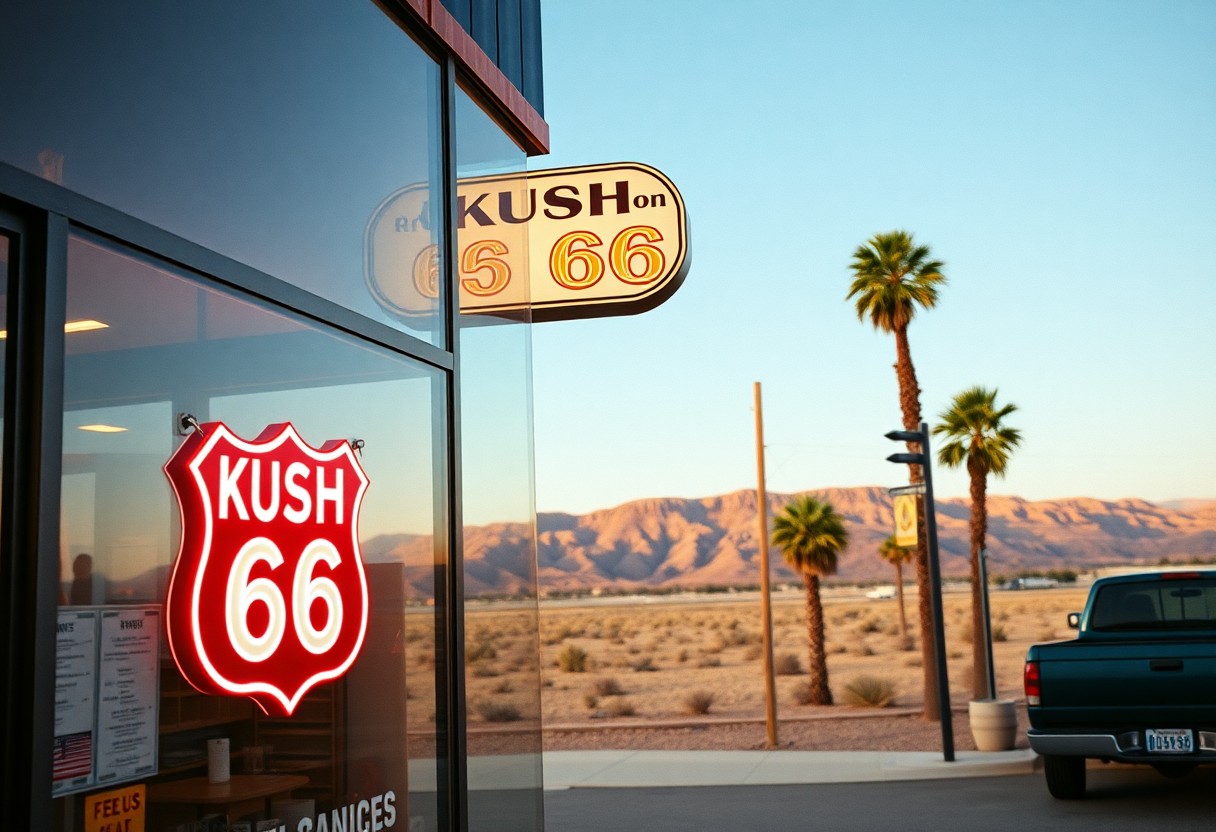
That makes the story of the modern cannabis consumption lounge considerably more interesting than simply the story of a new kind of retail business. Around the world, cannabis lounges and social spaces have evolved from informal gathering places into carefully regulated destinations. In California, that evolution has taken a distinctly American turn. And along historic Route 66 in Needles, California, Kush on 66 is writing a new chapter in that historic highway story.
Kush on 66 is a recreational cannabis dispensary and consumption lounge where the old highway meets a distinctly 21st-century form of roadside hospitality. Our lounge is the first of its kind along historic Route 66 in Needles. We combine cannabis retail with a place where adults can relax, socialize and enjoy their purchases responsibly.
But to understand why that is significant, it helps to take a little trip around the world first. Cannabis is hardly a new arrival on the cultural landscape.
The International Story
For centuries, societies in Asia, Africa, the Middle East and elsewhere used cannabis for medicinal, spiritual and recreational purposes. The idea that cannabis consumption should be completely separated from ordinary social life is a relatively recent concept.
In the United States, cannabis was once widely available as a medicinal product before the emergence of modern prohibition during the first decades of the 20th century. Increasingly restrictive laws pushed much of cannabis culture underground. And underground cultures have a habit of creating their own gathering places.
The result was a fascinating American societal evolutionary story. By the mid-1950s cannabis consumption was associated with music, art, conversation, beatnik counterculture and community.
In other words, cannabis culture in the United States developed along lines similar to what had existed around coffee, tobacco, alcohol and music. It was a social culture.
Trendsetting
When people think about cannabis lounges, one city usually comes to mind first – Amsterdam in the Netherlands. This country took a distinctive approach to cannabis policy beginning in the 1970s. Rather than treating cannabis exactly like harder drugs, Dutch authorities developed a policy of tolerance. By the 1980s, cannabis coffeeshops had emerged as recognizable retail and social spaces.
The name can be misleading to an American. Simply put, you went to a Dutch coffeeshop for more than coffee.
These establishments became famous around the world for allowing adults to purchase cannabis in a relatively conventional hospitality setting. The Dutch model became an important influence on later cannabis distribution systems, including developments in the United States.
The Dutch model wasn’t exactly legalization in the way many Americans understand the word. Cannabis remained technically illegal under Dutch law, while sales through coffeeshops operated within a system of governmental tolerance and regulation. Still, the cultural impact was enormous.
A Broader Perspective
Spain developed another fascinating model, the cannabis social club. Beginning in the 1990s, cannabis social clubs emerged as community-based organizations. They operated within the complicated boundaries of Spanish law. Rather than functioning simply as retail stores, clubs were membership based.
Uruguay went further. In 2013, Uruguay became the first country to establish a nationwide legal framework for recreational cannabis. There were three legal supply models: home cultivation, cannabis social clubs and pharmacy sales. The social clubs became another example of how cannabis could be incorporated into a regulated social environment.
Meanwhile in the United States, decades were spent pursuing prohibition while cannabis consumers, activists and medical users developed their own informal networks and gathering places.
California Sets The Pace
California became one of the great laboratories for change. The state’s medical cannabis movement created dispensaries and patient communities long before recreational cannabis became legal. And some businesses began experimenting with spaces where people could consume cannabis rather than simply purchase it and leave.
That distinction matters. A dispensary is fundamentally a retail experience. A lounge is a hospitality experience.
California voters approved Proposition 64 in November 2016. This legalized specified recreational marijuana uses and created a regulatory structure for adult-use cannabis. Importantly for the future of lounges, the measure allowed local governments to authorize licensed
Consequently, California’s cannabis landscape became a patchwork of local experimentation. Some communities said yes while others were an adamant no.
A Modern Perspective
That local-control philosophy is one reason the California cannabis experience is so different from one community to another. State law establishes the framework, but local governments play a major role in determining what happens on Main Street.
Not surprisingly, San Francisco became one of the nation’s pioneers. A medical dispensary opened in the historic Barbary Coast district in 2013. The facility included an on-site lounge, creating a setting that looked less like a conventional retail store and more like an old-fashioned club or neighborhood watering hole.
The concept evolved from simple consumption rooms into increasingly sophisticated environments featuring comfortable seating, music, entertainment and social interaction. Then came another milestone.
In 2019, Lowell Cafe in West Hollywood opened as America’s first licensed cannabis consumption restaurant. That took the idea one step further by combining cannabis consumption with a restaurant-style hospitality experience.
And Now A Route 66 Story
That brings us to Needles. And it brings us to a new chapter in the Route 66 story.
Today, travelers along Route 66 encounter vintage gas stations restored as museums, diners that have survived generations, roadside attractions built around giant fiberglass creatures, and, in Needles, a cannabis dispensary and consumption lounge. That makes Kush on 66 an intriguing addition to the continuing history of the highway.
Kush on 66 brings together two very different pieces of American history. One is the history of cannabis culture and the evolution from prohibition toward regulated adult-use businesses. The other is the history of Route 66 as a place where travelers stop, linger and experience something unique to the community they are visiting.
That is why the concept of Kush on 66 has such an interesting relationship with travel. Road trips have always depended upon places that invite travelers to pause. The best roadside businesses aren’t merely places where you purchase something. They’re places where you collect a story. Kush on 66 embraces that idea with a distinctly Needles flavor.